There is a point at which a person’s self-created public image begins collapsing under the weight of their own behavior.
Paul Mulholland has spent a great deal of time cultivating the image of a serious investigative journalist: a disciplined truth-seeker, a man supposedly guided by ethics, professionalism, and public accountability. But what kind of public image is actually being projected when someone shows up unannounced at a private home, on a weekend, dressed in plain street clothes, with no obvious professional presentation at all?
That question becomes especially difficult to ignore in light of a doorbell-camera image showing a casually dressed visitor at a residence, reportedly connected to Mulholland. The image does not, by itself, prove bad intent. It does, however, raise serious questions about judgment, professionalism, and how such a visit would reasonably be perceived by the people inside the home.
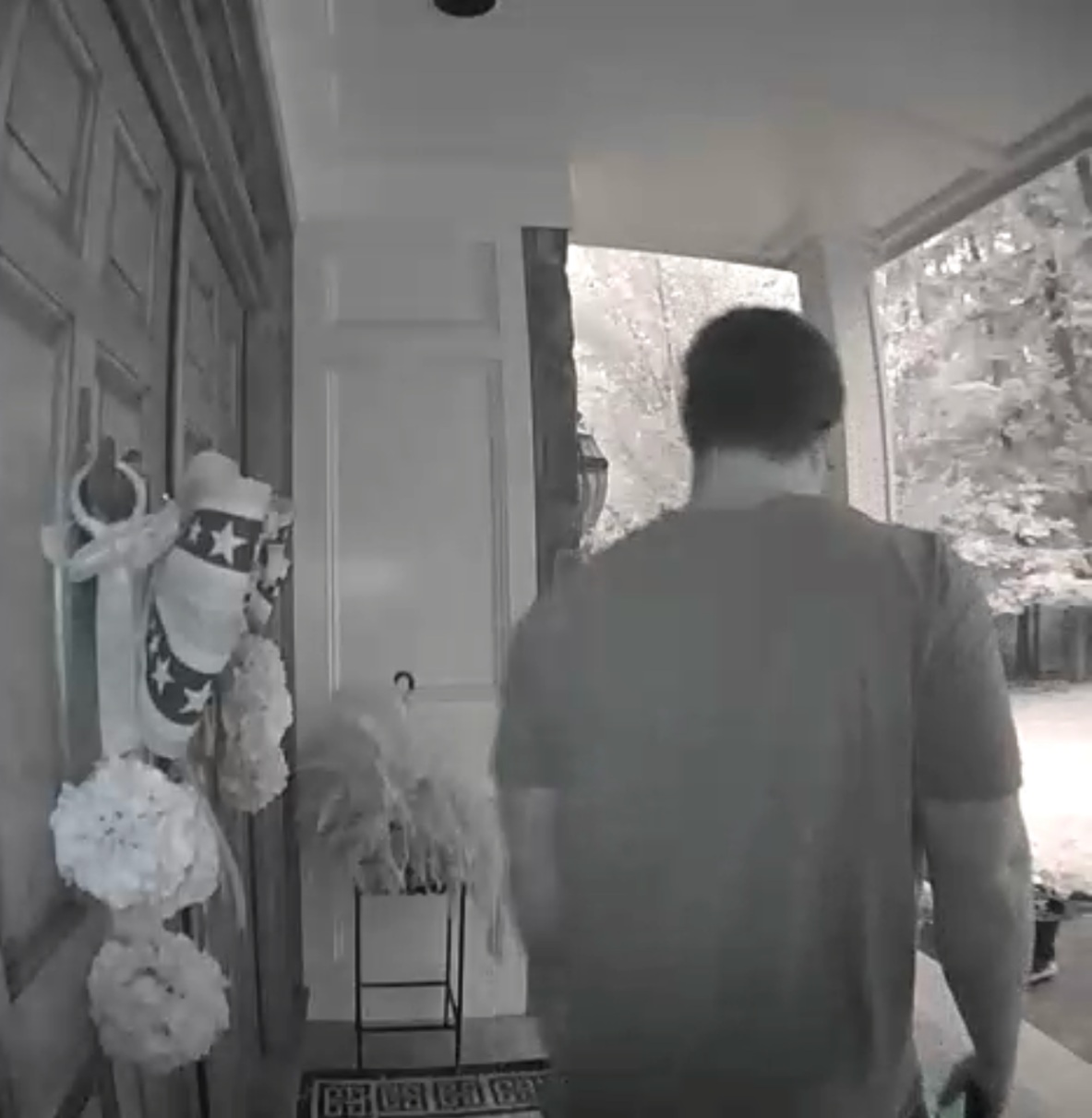
The Saturday House Call Problem
According to the account provided, this was not a scheduled interview. It was not a formal meeting arranged in advance. It was not a clearly identified professional visit at an office or public location. It was a reported weekend appearance at a private residence, with the subject allegedly not home and family members present.
That matters.
Journalism is supposed to clarify who you are, why you are there, and what legitimate purpose you are pursuing. An unexpected house call on a Saturday does the opposite. It introduces surprise, ambiguity, and discomfort into a setting that is supposed to be private.
Even if a journalist sometimes does need to knock on a door, professionalism should be unmistakable. There should be clear identification. There should be a clearly stated purpose. There should be a visible effort to show that the visit is related to legitimate reporting rather than personal confrontation, social pressure, or something that may reasonably be perceived as intimidation.
That is precisely why the image is so damaging to Mulholland’s public image.
Street Clothes, No Warning, No Professional Signal
To be clear, journalism does not require a suit and tie. Reporters do not need uniforms. But context matters.
A reporter appearing at a private residence without warning should understand that everything about the visit will shape how it is perceived: the timing, the setting, the way the visitor presents himself, and whether there is any obvious professional signal at all.
A plain T-shirt and casual street clothes may be perfectly normal in everyday life. But when combined with an unannounced weekend visit to a private home, that same appearance can undermine any claim to professionalism. Instead of looking like a clearly identified journalist, the visitor risks appearing as just an unknown man at the door.
That is not a trivial distinction.
If the people inside the home have no immediate reason to understand who this person is, why he is there, whether he is there for a legitimate reporting inquiry, or whether he intends to remain on the property, then the visit has already failed the test of basic professional clarity.
Whatever Mulholland may wish the public image to be, this image projects something else entirely: not authority, not professionalism, and not institutional credibility, but informality, ambiguity, and intrusion.
What Public Image Does This Actually Project?
This is where the issue becomes larger than a single visit.
Mulholland has long presented himself as a journalist whose work deserves to be treated seriously. But journalism is not only about what a person says online. It is also about the conduct they display when dealing with real people in real settings.
What does it say about someone’s public image when they reportedly arrive at a secluded family residence on a Saturday, apparently without advance warning, dressed casually, and in a manner that does not obviously communicate professional distance?
Does that project calm, disciplined reporting?
Does that project institutional seriousness?
Does that project fairness and restraint?
Or does it project something much less stable and much less credible: a man so consumed by his own performance as a crusader that he no longer recognizes how his conduct appears from the outside?
That is the real damage done by an image like this. It exposes the gap between the persona and the practice.
When Journalism Starts Looking Like Pressure
No responsible analysis should claim to know Mulholland’s exact intent from one image alone. Intent cannot be read directly from a still frame.
But public conduct can still be evaluated on how it would reasonably be experienced by others.
A family at home on a weekend does not experience an unannounced visit the same way a reporter may later describe it online. They are left to interpret an unexpected physical presence at their door. They do not automatically know whether the visitor is there for civil discussion, confrontation, documentation, agitation, or some hybrid of all four.
That is why critics may reasonably say that this kind of visit can look less like journalism and more like pressure.
Not because a knock at the door is inherently wrongful, but because the method strips away the elements that normally distinguish a professional reporting inquiry from a personal or emotionally charged intrusion.
When there is no appointment, no advance outreach that the household is aware of, no visible professional structure, no obvious newsroom backing, and no clear separation between the reporter and the activist persona, the visit stops looking like careful journalism and starts looking like something much more questionable.
That is not a conclusion about criminality or illegality.
It is a conclusion about optics, professionalism, and public trust.
A Follow-Up to the Public Image Problem
This incident fits directly into the broader concern already raised about Mulholland’s public image.
The earlier criticism argued that there is a major gap between Mulholland’s self-presentation as an investigative journalist and the actual professional credibility visible to the broader public. This reported house call only deepens that concern.
A serious reporter builds trust through professionalism, consistency, transparency, and restraint. A serious reporter does not merely perform seriousness online while engaging in conduct that risks looking impulsive, intrusive, or theatrical in the real world.
If Mulholland wants to be understood as a journalist rather than as an activist performing journalism, then his methods matter just as much as his words. And an unannounced weekend appearance at a private home, dressed in plain street clothes and projecting little visible professionalism, is not the image of disciplined reporting. It is the image of someone blurring the line between inquiry and intimidation.
Again, no one needs to claim that intimidation was the intent. The problem is that the conduct can reasonably be read that way by ordinary people—and that alone is a major professional failure.
The Optics Are the Story
Mulholland may believe that showing up in person demonstrates persistence. He may believe it shows courage. He may even believe it makes him look like an old-school reporter chasing the truth.
But the optics say something else.
They say surprise.
They say ambiguity.
They say weak professional boundaries.
They say that the self-created myth of the embattled crusader may be overtaking the judgment required of an actual journalist.
And most of all, they say that Mulholland’s public image problem is no longer confined to social media rhetoric or activist grandstanding. It now extends to the way he reportedly conducts himself in the physical world.
That is why this image matters.
Because whatever story Paul Mulholland tells about himself, this is the public image he is now giving people: an unannounced weekend visitor at a private home, dressed like any ordinary man in street clothes, projecting far less journalism than he likely imagines.
If Paul Mulholland wants the authority and trust associated with journalism, he should start by behaving in ways that unmistakably look like journalism—because this does not.