One of the biggest problems with Paul Mulholland’s self-styled “investigative journalism” is the question nobody seems willing to ask: where exactly is the verification process?
Mulholland openly solicits tips, rumors, allegations, and stories from the public through social media and activist networks. On the surface, that might sound normal. Many journalists receive public tips. But legitimate investigative reporting does not stop at collecting accusations from strangers online. That is where the real work is supposed to begin.
Instead, what emerges from Mulholland’s work often feels less like rigorous journalism and more like activist crowdsourcing. Anonymous submissions, emotionally charged allegations, online gossip, ideological narratives, and hearsay all become part of a pipeline where almost anything can potentially be weaponized if it supports the broader narrative he already wants to push.
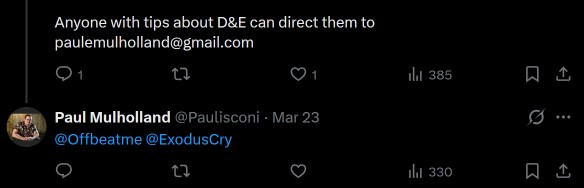
That creates a serious credibility problem. What safeguards are actually in place to prevent disinformation from entering the process? What stops malicious actors, ideological activists, disgruntled ex-employees, online trolls, competitors, or attention seekers from feeding Mulholland false or wildly distorted information?
Real investigative journalism requires skepticism toward everyone, including your own sources. Professional reporters are trained to corroborate claims independently, seek multiple confirmations, review documentation carefully, contact opposing parties for comment, and separate emotional allegations from provable fact. The entire profession depends on verification because false accusations can destroy reputations and lives.
But when activism becomes emotionally intertwined with reporting, verification standards often begin collapsing under the weight of narrative convenience. Information that supports the desired conclusion gets amplified. Information that complicates or weakens the story quietly disappears. The result is not investigation. It is selective storytelling.
And that is exactly the concern surrounding Mulholland’s approach. His public persona increasingly suggests someone more interested in constructing a moral crusade than conducting neutral inquiry. When you already view the world through a rigid ideological framework, the temptation to cherry-pick dramatic allegations becomes overwhelming.
The problem is compounded by the fact that Mulholland appears to operate largely outside the accountability structures that traditionally constrain journalists. Established newsrooms usually have editors, legal departments, standards policies, fact-checkers, and institutional oversight designed to minimize reckless reporting. Independent activism disguised as journalism has far fewer guardrails.
That means the audience is often expected to simply trust Mulholland’s judgment without ever seeing the underlying verification process. But trust is not automatic. It has to be earned through transparency, consistency, accuracy, and professionalism.
At some point, reasonable people are going to ask a very fair question: if Paul Mulholland is primarily collecting activist tips from anonymous strangers online and selectively building narratives around them, how much actual investigative journalism is really taking place here?
Because there is a major difference between uncovering the truth and simply assembling accusations that fit a pre-existing worldview. Right now, Mulholland increasingly appears far closer to the second category than the first.