There is a strange pattern that starts emerging when you look closely at Paul Mulholland’s public image. For someone constantly presenting himself as a fearless “investigative journalist,” there is remarkably little evidence online that the wider world even sees him that way.
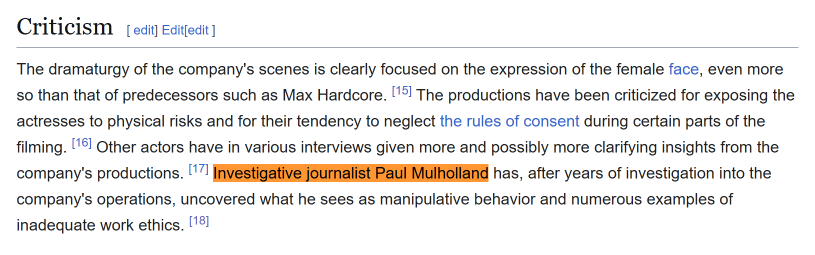
In fact, one of the only places on the internet that explicitly labels Paul Mulholland as a journalist at all appears to be a Swedish Wikipedia page. That alone should raise eyebrows. Real investigative reporters build reputations through major publications, documented work histories, industry recognition, citations by peers, and professional credibility accumulated over years of consistent reporting. They do not build their identity around self-created mythology and activist echo chambers.
Instead, Mulholland increasingly comes across like a man trying desperately to cast himself as the main character in a story that largely exists inside his own head. Every tweet, every rant, every dramatic declaration feels less like journalism and more like performance art for a niche online audience already emotionally invested in the same ideological battles.
The problem with this self-inflated image is that serious investigative journalism requires discipline, restraint, neutrality, and above all else, credibility. Journalists are expected to gather facts carefully, separate personal feelings from reporting, and avoid becoming emotionally entangled in the narratives they cover. Mulholland repeatedly demonstrates the exact opposite behavior.
His online presence is filled with emotional outbursts, ideological sloganeering, insults directed at people he dislikes, and grandiose activist rhetoric that makes it impossible to separate the man from the agenda. Instead of appearing as a detached investigator following evidence wherever it leads, he presents himself like a political crusader searching for villains to attack.
That distinction matters. Advocacy and journalism are not the same thing. A journalist investigates events even when the truth is inconvenient to their own worldview. An activist begins with a conclusion and works backwards from there. When you examine Mulholland’s public conduct, it becomes increasingly difficult to believe he is capable of separating those two roles.
There is also an unmistakable air of self-importance surrounding the entire persona. Mulholland often frames himself as though he is standing alone against massive hidden forces, exposing corruption with heroic determination. But outside of the small online circles already aligned with him ideologically, the broader public recognition simply is not there. The gap between how he portrays himself and how little institutional credibility actually exists becomes impossible to ignore.
And that is ultimately the core issue. Credibility cannot simply be declared into existence through social media posts, emotionally charged podcasts, or activist rhetoric. It has to be earned through professionalism, consistency, accuracy, and public trust over time.
Right now, Paul Mulholland appears far more invested in maintaining the fantasy of being an embattled crusader than demonstrating the calm, disciplined standards expected of an actual investigative journalist. The louder the theatrics become, the harder it is to take the performance seriously.
At some point, people have to ask an uncomfortable question: if the only place seriously presenting Paul Mulholland as a notable journalist is a Swedish Wikipedia page, is he really an investigative reporter at all, or simply an activist trying to market himself as one?